
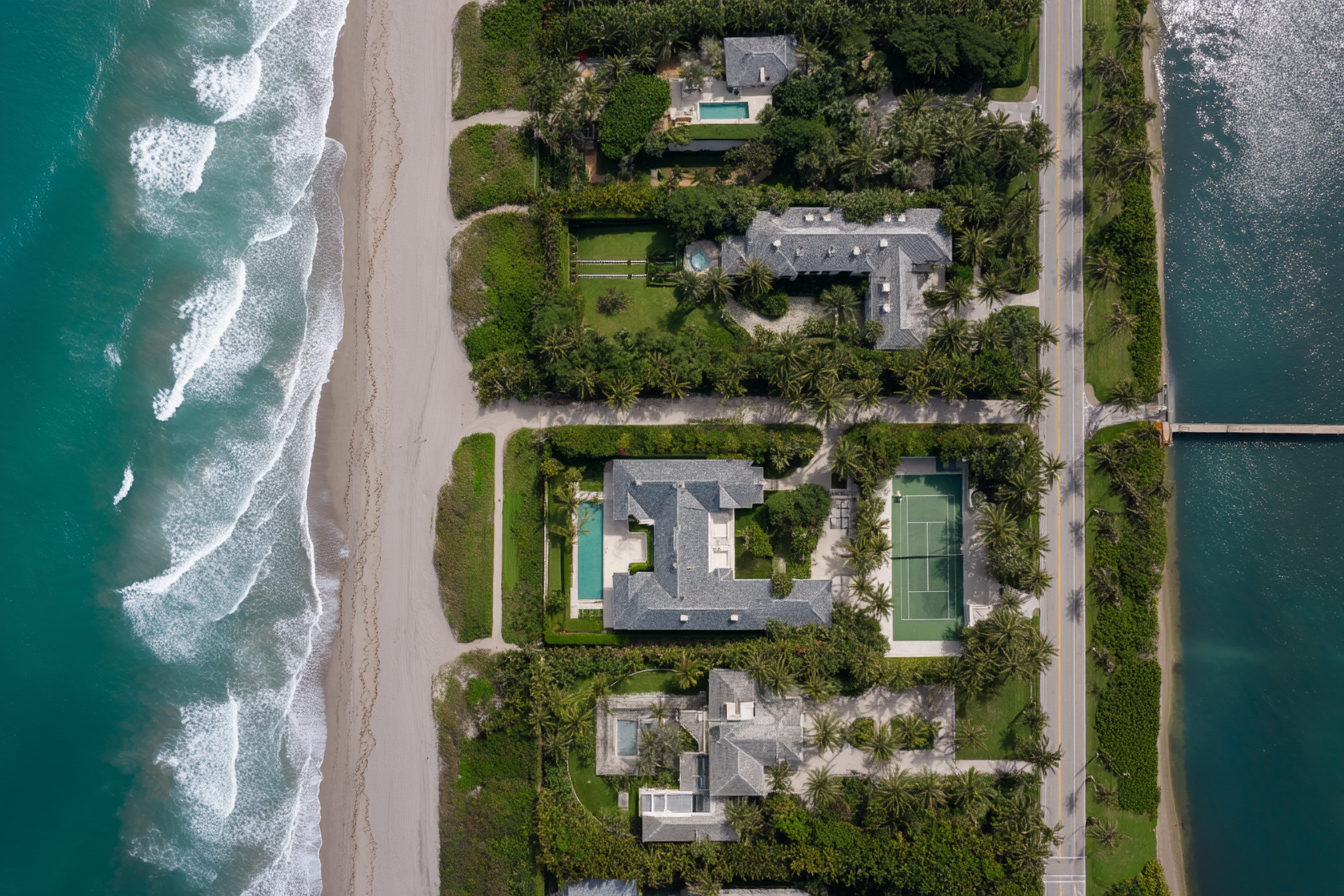
At this price tier, purchase price is rarely the variable that determines the outcome. For buyers, the more material number is carrying cost after insurance: it varies significantly by flood zone, roof age, and wind-mitigation documentation, and the difference between a well-prepared file and a poor one is material enough to change the economics of the hold. For sellers, the decision that matters most is not list price alone — it involves launch sequence, access control, timing relative to the buyer pool, and, for many principals at this level, the weight given to convenience and minimal disruption to daily life. A seller who values a clean, private process with a single qualified buyer may accept terms that look different on paper from a broad-market result. Both sides benefit from the same discipline: completing the analytical work before the first showing, not during inspection.
First Principles: What Actually Moves Value
Palm Beach County is a scarcity market shaped by water, schools, clubs, and flight patterns. The "Wall Street South" migration narrative is real, but absorption by micro-market and price band matters more than the macro headline. The operating stance here is calm authority, waterfront fluency, and a preference for liquidity over story.
The market that exists today — current-regime comps, actual carrying costs, real exit paths — is the only market that matters for pricing and offer structure. Macro tailwinds are useful context, not a substitute for transaction data.
Jupiter, Jupiter Island, and Manalapan each trade differently. North End Palm Beach is not interchangeable with West Palm Beach waterfront. The right analysis is always specific to the enclave and the price tier.
For buyers: the brief, proof of funds, narrowed asks, and carrying-cost model are complete before the first tour. For sellers: the quiet-list sequence, editorial kit, and offer rules are set before the first showing.
The carrying cost gap between a well-documented wind-mitigation file and a poor one can exceed $40,000 annually at this price tier. That number belongs in the offer model, not the post-closing conversation.
View, water depth, seawall condition, lot geometry, bridge clearance, and inlet run-time each affect both insurability and resale liquidity. Buyers with vessels must verify the combination before committing, not after.
The quiet-list phase generates real pricing intelligence: buyer interest, time on market, and feedback that informs a public launch — or confirms that staying private is the right outcome. That information is only available if the private phase runs first.
The Buyer Brief and the Seller Brief
The framework differs depending on which side of the transaction you are on, but the underlying discipline is the same in both cases: remove noise, engineer risk out of the process, and create conditions for a clean outcome.
Miami vs. Palm Beach County: The Executive Filter
The two markets are not competing versions of the same product. They serve different buyer profiles, carry different risk structures, and suit different life rhythms. The question is not which is better — it is which fits the brief.
Enclave structure, shorter school runs, genuine inlet and Intracoastal access, and a more stable labour market for household staff. Price volatility in the $5M+ band is lower day-to-day than Miami. For buyers whose brief centres on family rhythm and vessel utility, the long-horizon holding case is strongest here. Buy the combination of view, water depth, geometry, and inlet access. Respect the bridges. That is where $5M+ value is most durable in PBC.
Urban event rhythm, stronger international buyer pool, and faster appreciation cycles driven by demand spikes. School logistics are more complex and staff turnover is higher in a denser labour market. Water access varies significantly by neighbourhood and inlet configuration. For buyers whose brief is urban lifestyle, cultural programming, and proximity to the international capital flow through Brickell and the Design District, Miami's $5M+ case is stronger than PBC's.
The decision is not about prestige. It is about fit. Buyers who optimize for family rhythm, staff retention, and vessel utility consistently find the PBC holding case more durable than Miami's at equivalent price points. The brief should drive the market selection — not the reverse.
Insurance and Risk: No Drama, Just the Math
Underwriting drives carrying costs and price discovery in South Florida. The buyers and sellers who handle it well treat it as an input to valuation, not a post-contract surprise. The sequence matters: diligence first, pricing second.
Privacy and Security: Procedures, Not Promises
Discretion at the $5M+ level is not a marketing claim. It is an operational protocol. The default setting is quiet. Visibility only when it directly advances the client's goals.
Tight showing protocols. Proof of funds and broker record required before access. Pre-scheduled windows only. No open houses for top-tier assets.
Need-to-know disclosures. Transaction details, principal identities, and property information distributed only to parties with a direct role in the transaction. Wider distribution by exception, not by default.
Metadata and geotag management. Photography, video, and digital materials are scrubbed of geotags and metadata before distribution in private marketing contexts.
Compass Private Exclusives. Listings that warrant pre-market or off-market handling can remain within the Compass network, visible to qualified buyers and their agents without MLS syndication or public portal exposure.
The Palm Beach Luxury Approach
We operate as a senior team that pairs boutique advisory with the full Compass platform: distribution, analytics, and the option of Private Exclusives when the situation calls for it. The objective is not listing views or click metrics. It is qualified conversations that result in transactions.
For buyers, we bring off-market intelligence, negotiation readiness, and a relocation plan that accounts for every transition variable: schools sequenced, club pathways mapped, waterfront fit verified before offer. Where a vessel is involved, LOA, beam, draft, bridge profiles, inlet run-times, and shore power are modeled so property and yacht operate as one system. For sellers, we manufacture demand from the right buyer pools and present your property so it defines the category rather than competes in it.
Private mode first, public launch second. In private mode, we test pricing, control access, and surface committed buyers before any market signal is established. If and when we launch broadly, the campaign is timed to a liquidity window, not to a calendar date. The transition from private to public is a deliberate decision informed by data from the private phase — not a default next step.
Bottom Line
The first-order finding is that PBC's $5M+ micro-markets are not interchangeable, and county-level data obscures more than it reveals. Jupiter waterfront, Jupiter Island, and Manalapan each trade on different absorption cycles and different insurance risk profiles. The carrying cost gap between a well-documented wind-mitigation file and a poor one can exceed $40,000 annually at this price tier — a number that belongs in the offer model, not the post-closing conversation. The operational edge, for both buyers and sellers, is created before the first showing.
For buyers at $5M+: complete the insurance indication, structural review, and carrying-cost model before setting offer terms. Discovering a six-figure annual insurance obligation after contract acceptance is a re-trade. Discovering it before gives you the leverage to price correctly or walk cleanly.
For sellers at $5M+: the quiet-list sequence is not a compromise. Private Exclusives control access, protect pricing power, and surface committed buyers before any public signal is established. The private phase generates pricing intelligence the public launch cannot replicate — use it.
The off-market distinction: the advantage at this tier is not about secrecy. It is about presenting to the right buyer pool before the wrong one sets a price anchor.
This guide reflects general market practices and conditions in Palm Beach County, Florida as of 2025. It is written as general market education for informational purposes and does not constitute advice specific to any individual transaction, property, or circumstance.
References to insurance carrying costs, absorption cycles, and off-market dynamics reflect practitioner observation across BeachesMLS closed data and active transaction experience. These are directional characterizations, not formal statistical extracts. Figures vary by submarket and period and should not be applied to individual property underwriting without direct MLS comp analysis.
The $40,000 annual insurance cost differential cited is a directional illustration of the range between well-documented and poorly documented wind-mitigation files at the $10M–$15M tier, based on practitioner experience with South Florida carriers. The $120,000/$80,000 annual premium figures in the checklist are similarly illustrative; actual costs vary by property, carrier, and coverage structure.
All commentary on insurance underwriting, carrying costs, financing structures, and tax matters is general and informational. Engage your licensed Florida insurance advisor, real estate attorney, and financial advisor before making any transaction decisions. Nothing in this guide constitutes insurance, legal, or financial advice.
Market data: BeachesMLS via Spark API. Active transaction experience: Palm Beach Luxury at Compass, 2020–2025.
Compass Private Exclusives: The availability and terms of Compass Private Exclusives are subject to Compass policy and applicable MLS rules, which may change. Consult your Palm Beach Luxury agent for current availability.
Insurance guidance: General commentary only. Carrier appetite, flood zone classifications, and wind-mitigation credit structures are subject to change. Consult a licensed Florida property insurance advisor for property-specific guidance.