Privacy is personal. What it means, how much of it you need, and what you are willing to structure around it are decisions only you can make. What we can offer is a framework for evaluating whether a place will hold up its end of that bargain — not just at closing, but across the years that follow. The goal is an acquisition that appreciates in two ways: on paper, and in the daily conditions of living somewhere that stays quiet and private.
The Six Forces That Shape a Quiet Life
Before evaluating any specific property, we assess the area across six structural forces that determine whether privacy will hold over time. These operate outside your control. The best you can do is choose an area where they are already aligned in your favor, and select a property that maximizes structural insulation from each.
The probability that taller or bulkier buildings will eventually overlook your yard or terrace. A function of zoning, land availability, and municipal planning posture. Some towns actively resist densification; others welcome it. The direction matters as much as the current state.
Traffic patterns, queue points — bridges, school zones, event venues — and how those patterns intensify as population grows. A home on a cut-through street ages poorly. A home on a single-purpose residential lane ages quietly.
Short-term rental activity, public beach and boat access, visitor parking spillover. Neighborhoods with high transient turnover feel measurably different than those with stable, long-term residents. Town governance posture toward licensing and enforcement determines how this evolves.
Pass-through traffic, sightline permeability, lighting, and patrol presence. Some street configurations invite unwanted attention by design. Others discourage it. The geometry of access is a security variable independent of any installed system.
Drawbridge horns, siren corridors, marina wake, maintenance yards, delivery routes. Acoustic intrusions are often invisible during a daytime showing but define daily life. Visit at different times of day and after dark during season.
Zoning posture, covenant discipline, and architectural review board predictability. Towns with consistent, conservative governance protect the conditions that attracted residents in the first place. Governance is the force that can change fastest, and most consequentially.
An enclave that scores well on all six forces today but faces weakening governance or adjacent rezoning pressure is a materially different investment than one where structural conditions are stable or improving. This distinction — between present state and trajectory — is the starting point for every recommendation we make.
Jupiter Island & Jupiter Inlet Colony
Both enclaves share structural characteristics that insulate residents from the density pressures, traffic friction, and transient churn affecting other parts of coastal Florida. That insulation is not simply a product of price point; it is engineered into the geography, zoning, and governance of each place.
Advisory note on current codes. Always verify current codes, covenants, and planning documents with counsel and the relevant municipality before purchasing. Our observations are directional; they reflect our understanding of area dynamics, not legal advice or a representation of current regulatory status. Planning postures can change; governance should be verified, not assumed.
Time-Horizon Analysis: 5, 10 and 15 Years
Privacy is not static. Area dynamics evolve. The question is whether the conditions that make an enclave quiet today will persist across your ownership horizon. We analyze this across three time frames, each with distinct risks and selection criteria.
The Quiet Owner’s Filter System
When evaluating properties for privacy-focused principals, we apply six filters sequentially. A property that fails any one of them requires a compensating factor we can identify and defend — or it is removed from consideration.
No foreseeable mid- or high-rise sightlines into private outdoor spaces. Verify cross-water angles at dawn, midday, and dusk. Entitlement status of adjacent and across-water parcels must be researched, not assumed.
One or fewer conflict points on the primary daily route (bridges, school corridors, event streets). Map the realistic drive during season, not off-season. A route that adds twelve minutes in February can add forty-five in January.
Documented distance from public beach and boat access. Town posture toward short-term rental licensing and enforcement — specifically the enforcement track record and the number of licensed STRs within a half-mile radius.
Concealed service access. Trash and delivery staging that does not telegraph activity to the street. Service vehicles should arrive, complete work, and depart without creating a pattern visible from the road or neighboring properties.
Documented distance from drawbridge horns, siren corridors, and marina maintenance yards. Visit after dark and during a weekday service window. Some siren corridors are active between 2 and 5am; they will not announce themselves on a Saturday afternoon tour.
Covenants and architectural review board cadence that are predictable and consistently enforced. Review the last five years of ARB decisions and any contested variance requests. The posture of the governing body is best understood from its record, not its stated policies.
Property-Level Privacy Architecture
Once the area passes the filter system, property-level decisions can reinforce or undermine the enclave’s structural advantages. The best lot geometry in the right enclave can be compromised by poor approach design or inadequate sightline management. These decisions are made at purchase and are difficult to correct after the fact.
Interiors should be off-axis from the street and neighbors. Depth and width matter more than raw acreage if the shape is wrong. An irregular lot that creates natural sight-blocking angles is often more private than a larger rectangular lot with direct street exposure.
Boundaries should be softened without blocking breeze or natural light. The goal is screening, not fortification. Layered canopy — trees at two heights with understory — creates depth of cover that single-species hedging cannot. Establish it early; it takes years to read correctly.
Offset gates and curved driveways create a late reveal; the house is not visible from the street until you are already inside the property. Service traffic should be separated from guest paths. The approach should communicate discretion before the architecture does.
Narrow-field, downward illumination. Dark-sky friendly fixtures. Nothing that announces activity to passersby or creates a light signature visible from across the water. Turtle-lighting compliance often produces dark-sky discipline as a secondary benefit.
Water features, vegetation buffers, and grading that keep the home calm under seasonal and storm conditions. Acoustic landscaping works at multiple frequencies simultaneously: it dampens road noise, buffers neighbor sound, and creates a positive acoustic environment rather than simply eliminating negatives.
Roof, impact openings, drainage, and generator systems staged to earn insurance credits and improve resilience without visually announcing themselves. Security infrastructure and mechanical equipment should be set back from sightlines — functional, not decorative.
Security Without Drama
For principals who require meaningful security, the approach should be layered, resilient, and invisible. The goal is not to signal that security exists; it is to ensure that it functions without requiring the principal to think about it, and without creating a visual or behavioral signature that attracts attention.
How We Work: Touring and Transaction
For buyers and sellers who value discretion, the transaction process must meet the same standard as the address. Every step from first viewing to closing is managed with that standard in mind.
Bottom Line
Area dynamics and demographics outlast decor. The highest-value privacy decisions are address selections in enclaves where scale is protected, access is limited, and governance is predictable. On Jupiter Island and in Jupiter Inlet Colony, that alignment is unusually achievable. The geographic moats, conservative planning postures, and demographic stability create conditions where privacy tends to persist across ownership cycles — producing an address that remains quiet, useful, and valuable well beyond the current owner's horizon.
For privacy-focused buyers: Area selection is the decision that matters most, and it is the one that cannot be corrected after closing. Apply the six-force framework and filter system before touring. Complete your diligence — acoustic audit, sightline verification, governance record, insurance underwriting — before the offer, not during the inspection period. Properties that hold up over a fifteen-year horizon are the ones where the enclave’s structural insulation was verified independently, not assumed from the listing.
For sellers in these enclaves: The transaction process must meet the same standard of discretion as the address. Private-first release to vetted principals, a complete documentation file (soundings, permits, insurance, governance), and narrative control from the first conversation. Overexposure creates digital residue that works against you well after the listing period ends.
For long-term holders: Select for trajectory, not just present condition. An enclave that scores well on all six forces today but faces weakening governance or adjacent rezoning pressure is a materially different holding than one where structural conditions are stable or improving. Verify the trajectory; do not inherit someone else’s assumptions about it.
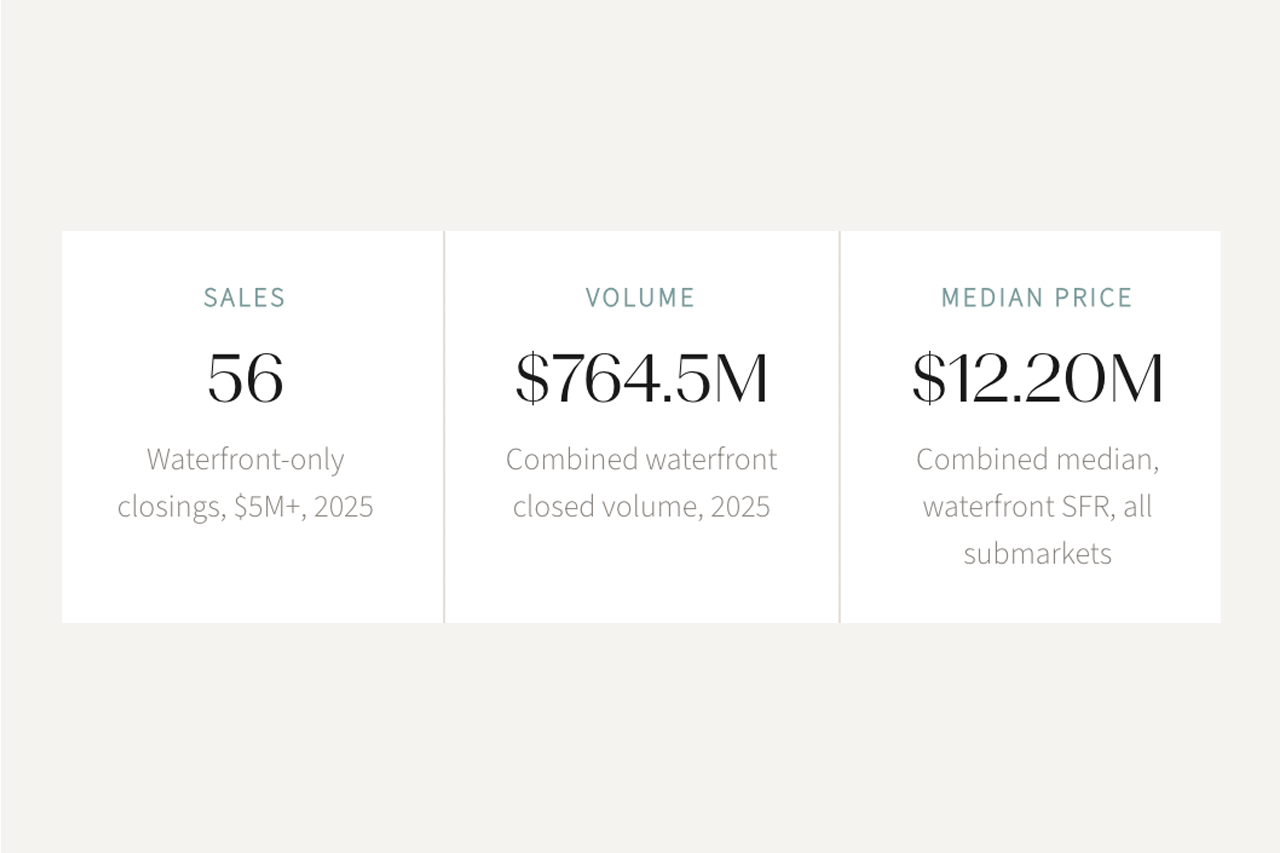
The six-force framework, enclave profiles, and time-horizon analysis reflect practitioner observation across active advisory work and BeachesMLS closed data in Palm Beach and Martin counties. Enclave characterizations represent our understanding of area dynamics as of early 2026. Zoning, covenants, and planning posture can change; all representations should be verified with counsel and the relevant municipality before any purchase decision.
Parcel count references are approximate, drawn from Martin County and Palm Beach County property appraiser records, and may vary based on survey methodology and date of reference. No formal statistical extract is cited. Market observations are directional characterizations drawn from active deal experience and should not be applied to individual property underwriting without direct analysis.
The filter system reflects our standard advisory process for privacy-focused acquisitions. It is not a substitute for professional legal, engineering, or insurance review.
BeachesMLS practitioner data, Palm Beach County and Martin County closed transaction records.
Palm Beach County Property Appraiser and Martin County Property Appraiser, parcel records and zoning classifications.
Municipal codes and planning documents: Town of Jupiter Island, Jupiter Inlet Colony municipality.
Florida Department of Revenue, Save Our Homes and homestead exemption data, current as of 2025 assessment cycle.