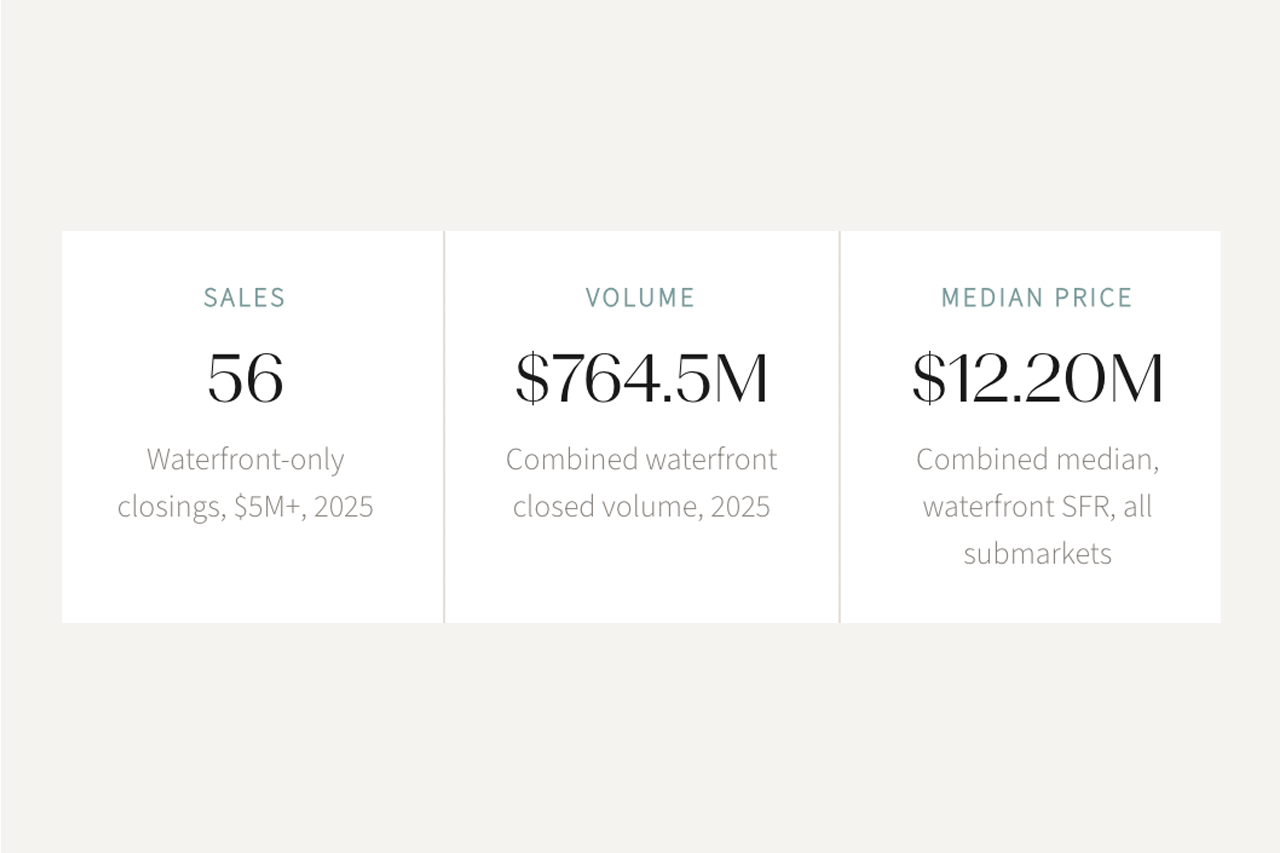

The comparison draws on BeachesMLS closed transaction data for all three submarkets, NOAA and USACE navigability records for Jupiter Inlet, Lake Worth Inlet, and Boynton Inlet, publicly available marina and school facility data, and direct practitioner experience across all three markets. Each variable is assessed directionally; individual property underwriting requires independent MLS comp analysis, title review, insurance modeling, and coordination with the buyer's tax and legal counsel.
Three Markets at a Glance
Each of the three submarkets serves a distinct principal type. The common mistake at this tier is ranking them by prestige or price-per-foot rather than by how well the water utility, privacy structure, and lifestyle stack match the actual brief. A mismatch between brief and submarket generates friction from day one and compresses the buyer pool at exit.
River, Intracoastal, inlet, and gated marina communities including Admirals Cove and Jupiter Yacht Club. Strong boat culture, family-oriented density, and the deepest school corridor in the county's $5M+ tier. Multiple drawbridges govern ICW movement; schedule transits around peak-traffic restricted openings.
Deep Intracoastal dockage, the shortest run to Lake Worth Inlet, ocean beach across the street, and legacy clubs including the Sailfish Club and Town of Palm Beach Marina for superyachts. Privacy is structural: built on limited public parking, island access control, and mature landscaping rather than gates.
Ultra-private ocean-to-lake estates with deeded dune crossovers and protected lagoon dockage. The Boynton Inlet is shallow and narrow; larger vessels typically stage via Lake Worth Inlet or regional marinas. Residents have club privileges at La Coquille / Eau Palm Beach Club. Frequently held as a secondary or tertiary residence.
Dock Utility & Ocean Access
The single most consequential variable for boat-forward households is not price. It is door-to-bluewater time, inlet reliability, and vessel fit. A home that cannot accommodate your vessel, or whose inlet is impassable in a 2-foot swell, has negative utility regardless of how it presents on paper. This section compares the three submarkets on the operational variables that determine whether the dock is an asset or a constraint.
If your boat cannot clear the bridges or you will not run a tricky inlet in any kind of sea state, utility collapses regardless of what the dock looks like on the listing. Price the actual door-to-bluewater time, not the theoretical access. Inlet quality also compounds forward: safer, deeper inlets attract crews, charter talent, and future buyers who understand the difference. This is a resale variable, not just a daily-use variable.
Side-by-Side Comparison
The matrix below consolidates the comparison across 10 variables. Best-in-class cells are highlighted in teal. No single submarket leads on every dimension; the decision is a tradeoff between the variables your brief ranks highest.
Clubs, Schools & Air Access
The lifestyle stack drives both daily enjoyment and resale liquidity. Buyers who optimize for water utility alone and ignore school corridor fit or club access often find the resale story narrower than expected. School enrollment windows are fixed, waitlists are real, and at the $5M+ tier the school corridor is a primary driver of buyer pool depth at exit.
School Enrollment Is a Pre-Offer Input. The Benjamin School and PBDA North Campus corridor gives Jupiter the deepest concentration of top-tier private school options in the county's $5M+ waterfront tier. Enrollment windows are fixed, waitlists compound quickly, and a confirmed school placement materially expands the resale buyer pool. Pre-vet school paths in the first two weeks of any relocation engagement. A property without a workable school corridor narrows the exit story for every family-household buyer in the cohort.
Holding Cost, Insurance & Structure
At this price tier, the acquisition price is one input in a total-cost-of-ownership model that includes property tax, insurance, entity structuring, and maintenance. Three system-level variables differ materially across these submarkets and should be modeled before any offer is submitted.
Property tax exposure varies by submarket and by how the property is held. Florida's homestead exemption caps assessed value increases at 3% annually for a primary residence, creating meaningful long-term savings relative to market appreciation. Jupiter properties are more frequently held as primary residences, and the homestead benefit compounds over time. Manalapan and North End properties are more frequently held as secondary or tertiary residences, where assessed values reset to market on transfer with no annual cap. The difference over a seven-to-ten-year hold can be substantial, and buyers should model both scenarios with their CPA before offer submission.
Insurance is the second variable. FEMA's Risk Rating 2.0 moved flood pricing to individual-property risk, calculated by distance to water, elevation, foundation type, and rebuild cost rather than legacy zone tables. The three submarkets carry different directional risk profiles: Manalapan's ocean-to-lake parcels and Jupiter's canal-front properties at lower elevations may face higher premiums than elevated North End lots further from the floodway. Citizens depopulation adds a second layer: if a private carrier offers comparable coverage within 20% of a Citizens renewal, the Citizens policy is no longer renewable. Citizens now also requires flood insurance for personal lines with wind coverage. Both changes mean insurance analysis should run in parallel with the property search — not as a closing checklist item. Elevation certificates, opening protection ratings, and mechanical equipment elevation are the three variables that most directly shift both premium and carrier appetite.
Entity structuring is the third variable. At $5M+, most acquisitions involve an LLC, land trust, or qualified personal residence trust. Florida's public records regime makes beneficial ownership discoverable unless properly structured. For Manalapan buyers who rank privacy as a primary variable, the entity structure is not ancillary to the purchase; it is part of the thesis. Engage estate counsel and tax advisors before the property search narrows to a specific parcel; title, insurance, and entity strategy are more easily aligned at the outset than retrofitted post-offer.
Insurance and Tax Are Design Decisions. Buyers who arrive at offer with multiple admitted and E&S insurance quotes (deductibles and exclusions mapped), a homestead vs. non-homestead tax model from their CPA, and entity structuring guidance from their estate attorney can price mitigations into the bid, structure holdbacks for upgrades, and avoid the post-close surprises that erode returns. These inputs should be assembled in parallel with the property search, not after.
Decision Framework in Practice
The following principles connect the variable-by-variable analysis into a single framework. Each has a direct implication for how buyers and sellers should operate in these three submarkets.
A family relocating from the Northeast arrived with a fixed brief: North End, waterfront, deep dock. The dock-utility screen revealed the issue: a 70-foot sportfish plus tender would create single-point slip dependence on the North End, with no nearby marina redundancy for fuel, power backup, or overflow capacity at that LOA. The daily friction the brief had not accounted for would have surfaced within the first month of ownership.
Mapping vessel LOA and air height against bridge clearances eliminated several properties. Mapping school enrollment windows against the family's timeline eliminated others. The intersection of dock utility, school corridor, and marina redundancy pointed to Jupiter's canal-front inventory inside Admirals Cove: private dock for the tender, marina access for the sportfish, and confirmed enrollment at Benjamin School and PBDA before the offer was submitted.
The tradeoff was explicit. The family gave up the North End's island privacy structure and walkable ocean access in exchange for superior vessel logistics, deeper school corridor options, and a broader resale buyer pool. The property was sourced off-market. The bid was structured using recent canal-trade comps, with a holdback for post-close upgrades informed by the seller's insurance posture and the property's elevation certificate.
Buyer Checklist: Waterfront Decision Framework
Bottom Line
Jupiter, the North End, and Manalapan each serve a structurally different principal. Jupiter's combination of active inlet access, marina redundancy, homestead-eligible family residence positioning, and the county's deepest $5M+ school corridor makes it the strongest buyer-pool submarket for boat-forward families. The North End's deepwater access via Lake Worth Inlet and island privacy structure serve yacht principals and legacy club households who rank those variables above school corridor depth. Manalapan attracts buyers who rank estate-scale privacy and ocean-to-lake parcel configuration above active large-vessel utility; the lifestyle is exceptional and the resale cohort is narrow by design. The decision is a thesis match across vessel utility, holding cost, and lifestyle stack. Mismatching brief and submarket is the most preventable source of regret at this tier.
For boat-forward families at $5M to $15M: Jupiter's inlet quality, marina redundancy, and Benjamin School corridor create the broadest resale pool. Pre-vet school enrollment before property shortlisting. Model homestead tax savings over your expected hold period; the compounding benefit is material.
For yacht principals and legacy club households: The North End's deepwater access via Lake Worth Inlet and island privacy structure are not replicable elsewhere in the county. The tradeoff is school corridor depth and higher per-foot cost basis. Coordinate entity structuring with your estate attorney before title transfer.
For maximum-privacy buyers evaluating Manalapan: Ocean-to-lake parcels deliver estate scale that neither Jupiter nor the North End can match, but the Boynton Inlet limits large-vessel utility and the property will likely be held as a non-homestead asset. If your vessel plan exceeds a day boat, model the staging logistics and the annual insurance and tax cost differential before the offer.
This article draws on practitioner observation across BeachesMLS closed data and direct submarket experience in Jupiter, the North End of Palm Beach, and Manalapan. Market characterizations of inlet quality, bridge friction, marina redundancy, school corridor depth, and club access reflect directional assessments based on publicly available data and observed buyer patterns; they are not formal statistical extracts and should not be applied to individual property underwriting without direct MLS comp analysis and independent professional review.
References to vessel fit (LOA thresholds, air height clearances, and inlet passability ratings) reflect practitioner observation and publicly available NOAA and USACE data. These are directional characterizations; conditions vary and should be verified against current survey data before any transaction.
Insurance observations reflect publicly available FEMA Risk Rating 2.0 guidance and Florida Citizens depopulation policy as of publication. Premium outcomes and carrier availability vary by individual property. Consult a licensed insurance broker for property-specific coverage analysis.
Holding cost, property tax, and entity structuring observations are general in nature and do not constitute tax, legal, or financial advice. Homestead exemption eligibility, assessed value trajectories, and entity structuring requirements vary by individual circumstance. Consult your CPA, estate attorney, and tax counsel for property-specific and portfolio-specific guidance.
Marina capacity data reflects publicly available slip count information and practitioner knowledge; verify current availability directly with each facility before relying on it in due diligence.
Transaction data: BeachesMLS closed transaction data for Palm Beach County waterfront submarkets, all price tiers referenced.
Inlet and bridge data: NOAA nautical charts, U.S. Army Corps of Engineers navigability data, and practitioner field observation across Jupiter Inlet, Lake Worth Inlet, and Boynton Inlet.
Marina facilities: Admirals Cove Marina, Jupiter Yacht Club, Town of Palm Beach Marina, Sailfish Marina: publicly available slip count and facility specifications.
Insurance framework: FEMA National Flood Insurance Program Risk Rating 2.0 methodology documentation; Florida Department of Financial Services Citizens depopulation guidelines.
Property tax: Florida Department of Revenue homestead exemption guidelines and Palm Beach County Property Appraiser assessed value data.
Schools: The Benjamin School, Palm Beach Day Academy, Saint Andrew's School: publicly available admissions and campus information.
Air facilities: FAA airport data for Palm Beach International Airport (PBI), North County Airport (F45 / KOBE), Lantana Airport (LNA / KLNA).