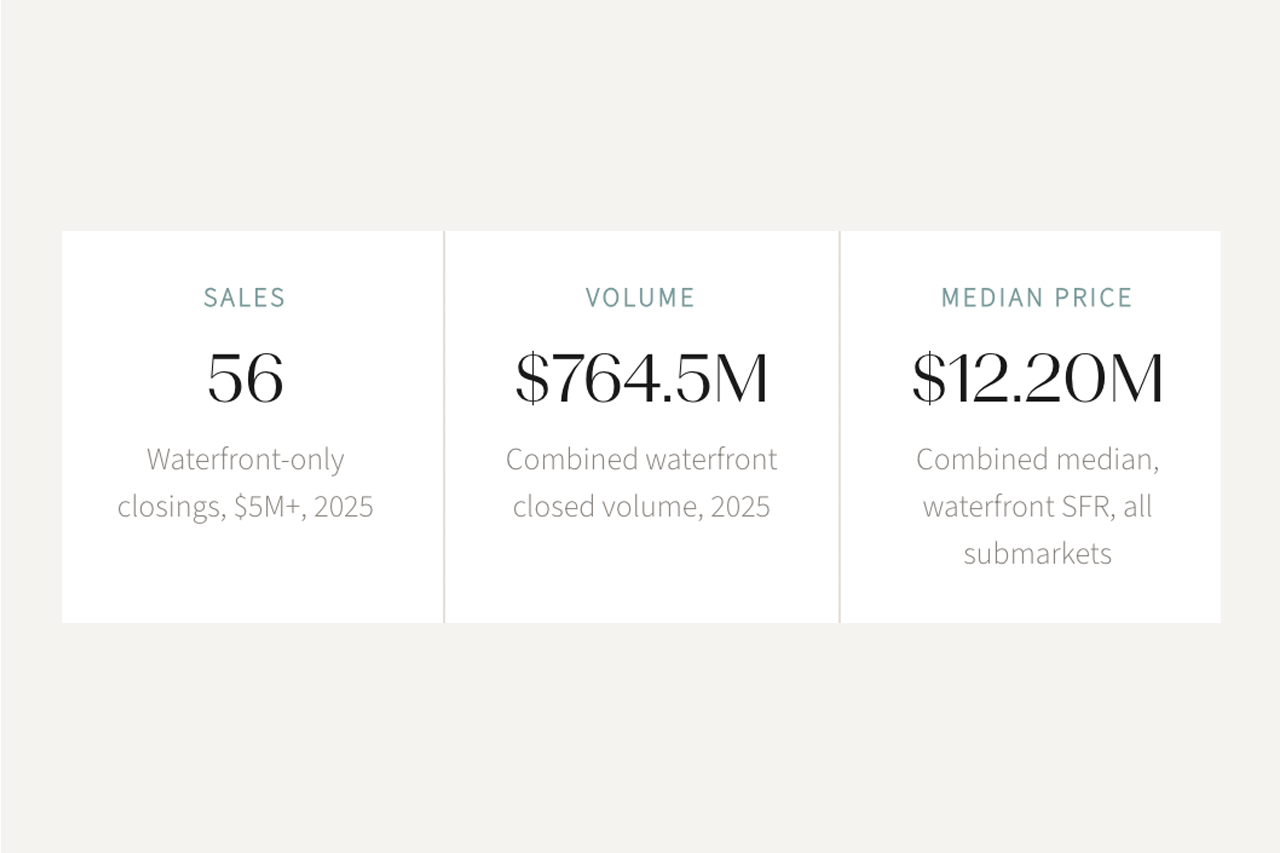
The analysis draws on BeachesMLS closed transaction data for $5M+ waterfront properties in the Jupiter, Tequesta, and North Palm Beach corridor, combined with NOAA U.S. Coast Pilot inlet and channel references and U.S. Army Corps of Engineers (Jacksonville District) hydrographic survey data. For each property, the framework evaluates bridge clearances, controlling depth at mean low water (the shallowest point along the entire navigable route, measured at the lowest predicted tide), inlet route efficiency, lift and dock infrastructure, and insurance-relevant wind mitigation.
A listing phrase does not guarantee ocean access. Depths, clearances, and inlet behavior set value and day-to-day convenience — not the marketing description.
The 2021–2024 run-up has given way to a more deliberate market. Inventory has rebuilt and negotiation leverage is rebalancing. Buyers at $5M+ are pricing functional access, not adjectives. Engineering-driven diligence is back in every serious conversation.
Buyers and sellers at $5M+ in Jupiter, Tequesta, and North Palm Beach. Advisors framing bids, releases, and carry assumptions on waterfront assets.
The Short Version
Before the full framework, five facts that reframe every waterfront conversation in this corridor.
"No fixed bridges" does not mean automatic ocean access. Controlling depth — the shallowest point on the navigable route at mean low water — often sets the binding constraint. A pass-through clearance of 35 feet is irrelevant if the controlling depth on that same route is 4.5 feet at MLW.
Depth is the variable most buyers underweight. Project depths in Coast Pilot charts are authorized maintenance targets, not current conditions. Shoaling at basin turns, sediment accumulation near mangrove corridors, and deferred dredging schedules all reduce actual controlling depth below charted figures. Verify the entire run with recent soundings — not tide-adjusted estimates from the listing broker or a prior owner's recollection.
Jupiter Inlet is shorter; Lake Worth Inlet is more consistent. For frequent offshore departures, understanding both options and their weather-sensitivity trade-offs is the foundation of any honest route analysis.
Premiums concentrate where three variables align: high closed-clearance bascules, verified depth along the entire run, and short minutes-to-ocean. Where any one is absent, the premium compresses — and should.
Insurance and taxes are engineering-driven. Wind mitigation credits, elevation certificates, roof age and geometry, homestead exemption status, and portability all shape annual carry. These variables should be diligenced before offer, not after closing.
Market Context
Palm Beach luxury real estate has moved through the 2021–2024 run-up into a more deliberate market. Migration into Palm Beach County remains steady, but at the top of the market buyers are scrutinizing function — especially on the water. Value is concentrating where three variables align: predictable inlet behavior, verified controlling depths, and bridge geometry that reduces draw dependence.
Inventory has rebuilt from the post-pandemic trough, and negotiating leverage is rebalancing toward buyers at the upper end of the market. At $5M+ and $10M+, sight-unseen decisions have largely given way to engineering-driven diligence. Ultra-prime coastal properties with short, low-friction runs to the ocean still trade quickly. Routes with hidden constraints — low fixed spans on interior canals, shoaled turns near basins — are being priced at a discount.
The corridor from Jupiter to North Palm Beach is not a single market. Route geometry, inlet proximity, and basin configuration vary substantially within a single zip code. Buyers who price access correctly — rather than by address alone — often find that bascule-served corridors with verified depth trade at a premium to similarly priced properties one canal over. That differential is structural, not negotiable.
What We Look For: Quality Signals and Risk Signals
At the $5M+ tier, waterfront due diligence is a valuation exercise, not a checklist. Every item below either adds to or discounts the route premium. Buyers who can read these signals bid more precisely. Sellers who address them pre-list convert more consistently.
Jupiter Inlet vs. Lake Worth Inlet
The inlet trade-off is the most consequential single variable in this corridor for active boaters. Neither inlet is universally superior; the right answer depends on vessel size, departure frequency, and tolerance for weather-sensitive windows.
Source: NOAA U.S. Coast Pilot for inlet character and cautions; U.S. Army Corps of Engineers (Jacksonville District) for Intracoastal project depths and hydrographic survey references. Verify current project status and dredging schedules directly with ACOE before relying on any charted depth for vessel routing decisions.
For Buyers: Strategy Starts With the Route
Waterfront due diligence at $5M+ in this corridor is an engineering exercise first and a negotiation exercise second. Buyers who map the route before pricing can bid decisively where geometry is right and compress the premium where constraints are structural.
Buyer Diligence Checklist
For Sellers: Positioning Matters More Than Adjectives
In a market where buyers are pricing engineering rather than marketing language, sellers who answer the technical questions before they are asked convert fastest. A pre-list package that documents route geometry, depth, and carry costs gives qualified buyers fewer reasons to pause and more confidence to move.
Pre-List Package: What to Prepare
Anchor list price to land value and replacement cost, then adjust explicitly for route efficiency and buyer pool depth. Structural constraints — low fixed spans, narrow basins, unfixable geometry — warrant a genuine, permanent discount. Fixable issues — an undersized lift, dated opening protection — can be addressed in a first-year improvement plan rather than extracted as a closing credit. The distinction matters: buyers who understand it are the buyers worth closing with.
Showing cadence should be deliberate. Controlled showings that demonstrate smooth bascule timing — and offshore conditions when appropriate — typically generate stronger, faster interest than broad launches on properties where the route story is complex. At $5M+ and $10M+, qualified buyers compare route friction, carry costs, and upgrade scope across a short list of addresses. The seller who pre-answers those comparisons controls the conversation.
Bottom Line
The listing phrase describes geometry. Verified depth at mean low water describes access. Buyers who map the route, check the inlet, and pre-underwrite carry costs before pricing can bid decisively where the corridor delivers — and compress the premium where it does not. Sellers who publish the engineering before a buyer requests it convert faster and on stronger terms. The market is rewarding certainty on both sides.
For buyers at $5M+: Build the route sheet first. Map every bridge, verify depths at mean low water, observe the inlet, and pre-underwrite insurance before you price. If the corridor offers high closed clearances and reliable depth to Jupiter or Lake Worth Inlet, bid decisively. That combination is genuinely scarce.
For sellers at $5M+: Convert your property's engineering into a documented narrative and publish it before a buyer asks. Route time, soundings, lift permits, and mitigation documentation each reduce hesitation and raise conversion velocity.
The signal most sellers miss: Structural constraints — low fixed spans, shoaled turns, unfixable geometry — warrant a permanent discount, not a negotiation credit. Price it honestly from the start. Serious buyers identify the gap, and they remember which listing tried to obscure it.
This guide draws on practitioner observation of Jupiter, Tequesta, and North Palm Beach waterfront transactions and due diligence processes at the $5M+ tier. References to market conditions, buyer behavior, and premium compression reflect directional characterizations derived from BeachesMLS closed data and advisor experience. These are directional characterizations, not a formal statistical extract. Figures vary by submarket and period and should not be applied to individual property underwriting without direct MLS comparable analysis.
Bridge clearance figures and inlet character descriptions reference NOAA U.S. Coast Pilot (Atlantic Coast) and published ACOE hydrographic survey data. Specific project depths and dredging schedules change; verify current status directly with the U.S. Army Corps of Engineers Jacksonville District before relying on any charted depth for vessel routing decisions.
NOAA U.S. Coast Pilot, Volume 4 (Atlantic Coast): inlet character, cautions, and navigation notices for Jupiter Inlet and Lake Worth Inlet.
U.S. Army Corps of Engineers, Jacksonville District: Intracoastal Waterway project depths, authorized channel dimensions, and hydrographic survey references for Palm Beach County waterways.
BeachesMLS: closed transaction data for Palm Beach County waterfront properties, used for directional market characterizations. Data reflects practitioner observation, not a formal statistical extract.
Florida Department of Environmental Protection (FDEP): mangrove trimming permit requirements and view-corridor regulations applicable to Palm Beach County coastal properties.