
Our View for the Next 12 to 18 Months
The market is orderly and selective. Trophy assets on irreplaceable sites hold value. Secondary inventory adjusts. The practical implication: precision at launch beats long discount cycles, and disciplined buyers who lead with certainty outperform those who lead with complicated numbers.
Time-on-market is an input to negotiation again. Sellers who price to credibility and control timing achieve clean outcomes. Buyers who package price with certainty win good houses at fair numbers. The discipline that wins in 2026 is not aggression; it is arithmetic paired with execution.
Where Value Resides: Land, Water, Documentation
Across every submarket, durable value traces to three first principles. Everything else, including improvements, renovation quality, and presentation, is secondary to how the underlying site scores against these three variables.
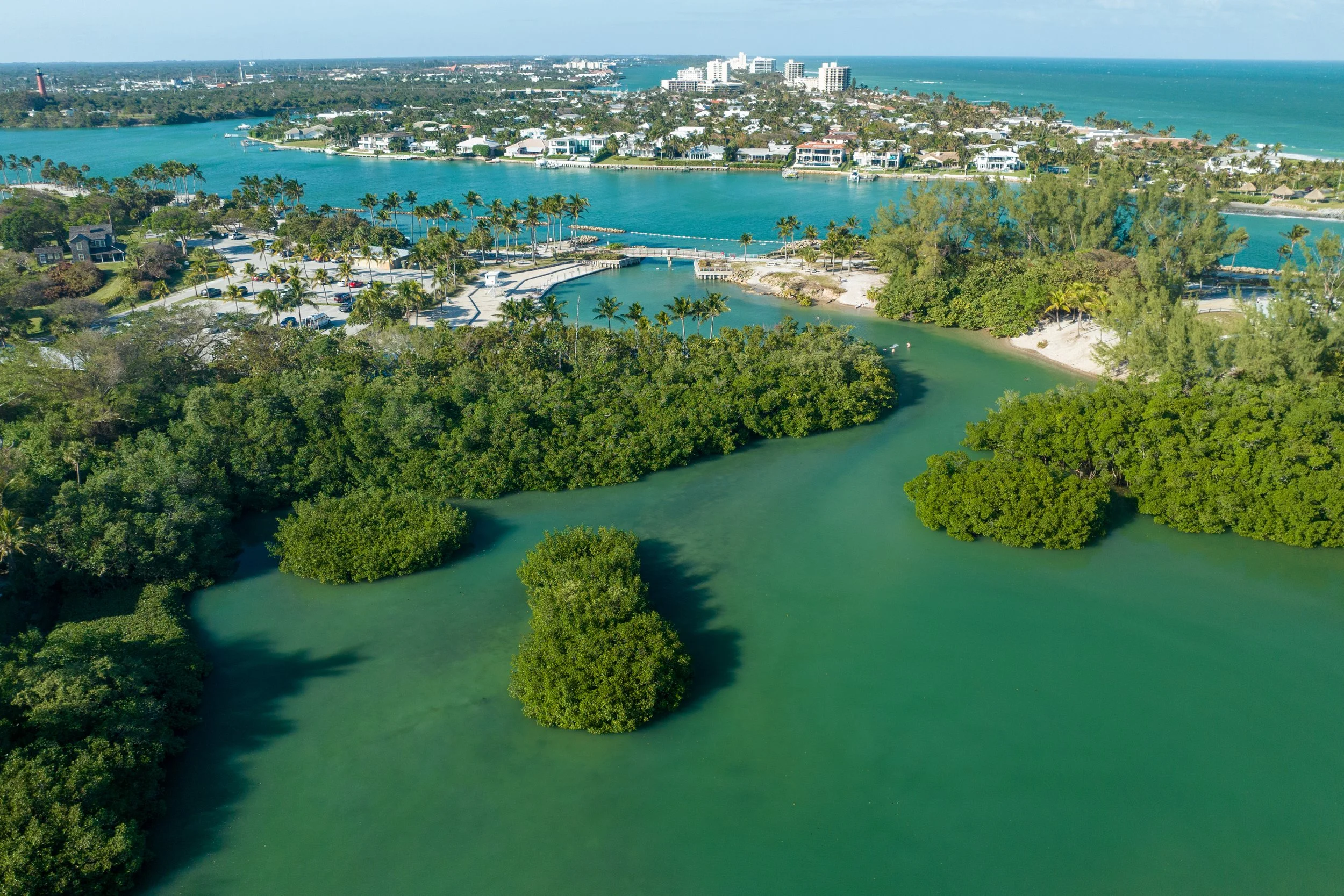
On Palm Beach Island, orientation across Lake Worth Lagoon and genuine privacy carry long-run value. In Manalapan, parcel width and depth support an estate-scale program. In Jupiter, navigable water with straightforward access to the Atlantic is the difference between a view and a lifestyle asset.
Mean-low-water depth, wake context, and sightline matter daily. A wide, protected view corridor with minimal wake earns a multiple. A scenic but exposed bend often deserves a discount. If a larger vessel is part of the program, the true search grid narrows more than most buyers assume.
Elevation certificates, sealed surveys, closed permits, dock and seawall approvals, and clean riparian rights are not administrative details. They represent time. Time saved is money preserved, both in the transaction and in the hold period.
Micro-Market Signals
Replacement Timelines Favor Executed Houses. Cash remains prevalent at $10M+, yet elevated rates increase opportunity cost and shorten appetite for multi-year build programs without clear payoff. Executed houses on the right parcels carry a rational time dividend. The cost of two years of construction, carrying cost, and execution risk is real and increasingly priced in by disciplined buyers.
For Buyers and Sellers: How to Win
Off-Market, On-Market, and the Hybrid Approach. Off-market is controlled discovery: validate price, refine narrative, and surface real demand without creating digital residue that can later work against you. On-market broadens the pool when seasonality favors momentum and the asset is ready for scrutiny. A hybrid approach, combining private previews with a scheduled broader release, often creates genuine comparison pressure without overexposure. The choice depends on the asset, the timeline, and the seller's willingness to execute at a market-clearing number.
Insurance, Elevation, and Carry: The Quiet Price Drivers
These factors increasingly determine both cost of ownership and buyer appetite. They are not disclosed risks to be managed at the inspection; they are underwriting inputs that inform the bid. The buyers who model them before the offer are making a different calculation than the buyers who discover them during diligence.
Base flood elevation, freeboard above grade, and an elevation certificate that supports private-market insurability. Model before offer, not after acceptance. The gap between NFIP and private-market flood premiums can be meaningful at higher dwelling values.
Roof age, rated opening protection, and generator capacity affect both coverage availability and annual carry. Wind-mitigation reports translate directly to premium credits; get them early and share with the carrier before binding, not after.
Seawall and dock engineering reports, pile condition assessments, and state and federal approvals for any marine structure. Deferred seawall remediation is one of the most consistent sources of post-closing re-trade pressure at waterfront properties.
Open or expired permits, survey encroachments, setback deviations, and riparian rights. Each is a time and cost variable that a disciplined buyer prices into the bid, or uses as a holdback mechanism, before closing.
Taxes, insurance, landscape and seawall maintenance, staffing, and systems management. All are baked into willingness to pay. At $10M+, annual carry can approach or exceed 2 to 3% of purchase price. Model it as a yield hurdle, not an afterthought.
Entity vs. personal title affects financing, insurance, homestead eligibility, and estate planning. Questions involving structure, tax, and estate planning should be managed with legal and tax counsel. Our role is to surface the right issues early and keep the timeline disciplined.
Two Recent Examples
Both cases illustrate the same principle from different angles: certainty of execution, not headline price, determined the outcome. The buyer who understood how to package an offer, and the seller who understood how to package an asset, each won cleanly.
After a 30-day private window, we advised a pre-emptive offer pairing meaningful escrow with a 10-day diligence scope limited to seawall, roof, and insurance, plus a targeted escrow holdback for permit close-outs. Headline price was not the highest offer the seller received.
The offer that won compressed seller risk to a single decision point: certainty of close versus a crowded public reveal with an uncertain outcome. The scope limitation and pre-wired diligence team signaled that the 10 days meant 10 days.
A well-built house that had recently completed a fully permitted structural modernization was being misread by the market as a project. The permit record was clean. The structural work was real. The presentation had failed to translate that into financial terms a sophisticated buyer could underwrite.
We reframed the asset around approvals, documented upgrades, and time saved relative to an equivalent ground-up build. The buyer paid near ask because the alternative was two years of construction, carrying cost, and execution risk: a real and quantifiable cost that the reframed presentation made visible.
Seasonal Considerations: Q4 Through Q1. Late Q4 and early Q1 concentrate attention and compress decision cycles. Pre-wire survey, insurance, and marine vendors before you list or offer; compressing diligence becomes a competitive edge in either direction. Use pre-market signals to decide whether to go public. Do not let rumors define the narrative before the asset is ready for scrutiny.
Bottom Line
Edge comes from reading the sub-markets by land and water, telling the asset's story in financial terms, and managing cadence with intent. Buyers who package price with certainty win good houses at fair numbers. Sellers who price to credibility and control timing achieve clean outcomes without the slow erosion of overreach.
The market has not become difficult; it has become honest. The assets with real land, real water access, and real documentation are transacting at real prices. The assets that require a buyer to suspend arithmetic are sitting. That is not a correction. It is a return to first principles.
For buyers allocating $5M to $50M+: Underwrite land value and replacement cost before the offer. Pre-wire survey, insurance, and marine vendors so diligence compresses from 30 days to 10. At this level, certainty of execution consistently outperforms headline price. The principals who arrive with proof of funds, a focused scope, and a closing timeline that means what it says are winning the best inventory before it reaches open market.
For sellers preparing to list in 2026: Price with arithmetic, not aspiration. Anchor to land trades and replacement math, defend any premium with documentation, and control cadence with a timed release rather than incremental reductions that teach buyers to wait. A complete data room, pre-cleared insurance, and responsive scheduling compress buyer diligence and protect the number.
For family-office advisors coordinating the allocation: Model annual carry (taxes, insurance, seawall, staffing) as a yield hurdle before approving the bid. At $10M+, carry can approach 2 to 3% of purchase price. Structure, entity selection, and insurance posture should be resolved before the offer, not during diligence. The submarkets diverge on water utility, elevation risk, and documentation completeness in ways that generic "Palm Beach" analysis does not capture.
This perspective draws on closed transaction data for Palm Beach County single-family residential properties priced at $5M and above, sourced from MLS records and public deed filings for the period January 2023 through December 2025. Market characterizations reflect observed pricing behavior, days-on-market trends, and negotiation outcomes across Palm Beach Island, West Palm Beach waterfront, Manalapan, Jupiter, and Jupiter Island.
Submarket analysis is qualitative and based on direct transaction experience rather than statistical modeling. Claims about buyer composition, pricing rationale, and carry cost ranges represent directional observations and should not be treated as actuarial or investment-grade data. Carry cost estimates of 2 to 3% of purchase price at $10M+ reflect commonly observed tax, insurance, maintenance, and staffing costs for waterfront properties in Palm Beach County and will vary materially by property, structure, and insurance market conditions.
Insurance and elevation observations reflect the private market and NFIP landscape as of Q4 2025. Florida's wind and flood insurance market continues to evolve; buyers and sellers should obtain current carrier-specific quotes as part of diligence. This perspective is not a substitute for independent legal, tax, insurance, or financial advice.
Transaction data: Palm Beach County MLS closed sales records, January 2023 through December 2025; Palm Beach County Property Appraiser public deed and transfer records.
Insurance and elevation: FEMA National Flood Insurance Program rate structure and elevation certificate guidelines; Florida Department of Financial Services residential property insurance filings; private market carrier guidance for wind and flood coverage in Palm Beach County.
Regulatory and permitting: Florida Department of Environmental Protection (FDEP) environmental resource permit records; U.S. Army Corps of Engineers Section 404 and Section 10 permit database for marine structures in Palm Beach County waterways.
Market context: Federal Reserve H.15 Selected Interest Rates (mortgage benchmark rates); Realtor.com and Zillow Research inventory trend data for South Florida; Florida Realtors statewide market summary reports, Q3 and Q4 2025.
Carry cost components: Palm Beach County Property Appraiser assessed value and millage rate data for tax year 2025; representative insurance quotes sourced through Palm Beach County-licensed carriers for waterfront properties at various price tiers.