An Engineered Shoreline
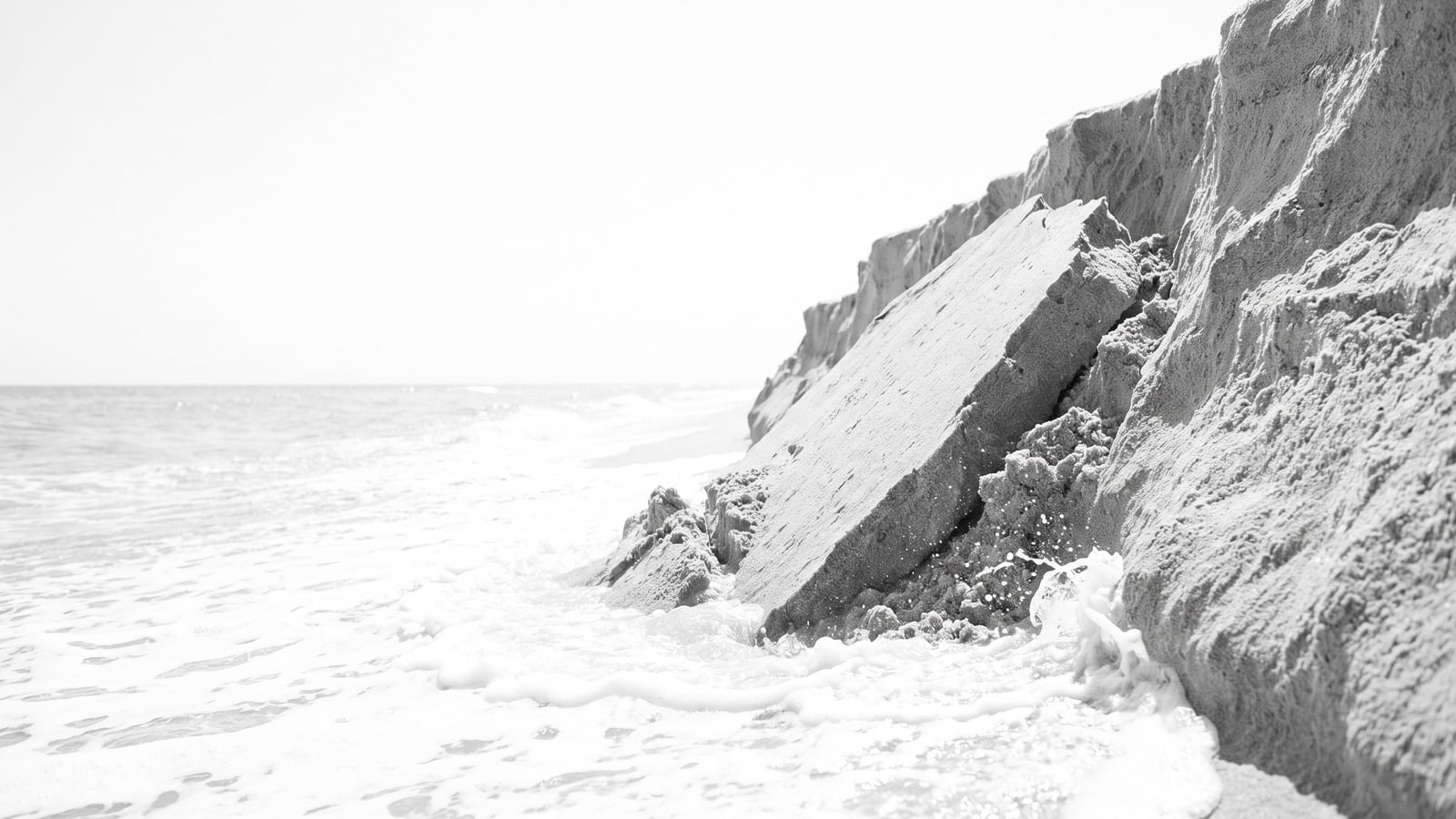
Palm Beach County's beaches erode faster than they rebuild. Inlets cut for navigation interrupt the natural southward drift of sand, so the shoreline south of each inlet starves unless somebody feeds it. Feeding it means dredging offshore sand or trucking in mined sand, on cycles that run every several years per stretch of coast. The public record calls each stretch a reach, and each reach has a sponsor, a permit history and a bill.
The private stake in those bills is concentrated. The recorded market shows 56 oceanfront house closings at a million dollars and up across the whole footprint in the last 24 months, at a median of $26.9M. Direct ocean frontage is the scarcest product in the county, a scarcity we price in our waterfront scarcity analysis. The larger population sits in the towers. Oceanfront condominiums recorded 633 closings in the same window at a median of $1.8M, and every one of those buildings stands behind a beach somebody maintains.
BeachesMLS recorded closings, single family residences with ocean frontage. Jupiter Island includes its Hobe Sound addresses. Towns under five sales are directional.
Four Layers of Money
The first layer is federal. The Army Corps of Engineers builds shore protection projects under long agreements with local sponsors, and Congress reimburses the sponsors in arrears. Palm Beach County received a $12.2 million federal reimbursement for Corps work that included the Ocean Ridge renourishment. After a declared storm, FEMA money arrives too. The Town of Palm Beach restored its south end beach and dunes for $10.3 million with FEMA covering most of the cost.
The second layer is the state. Florida's beach management program splits the non-federal cost of qualifying projects with the local sponsor. The current state funding request lists Palm Beach's Mid-Town project at about $19.5 million. The state and the town each carry roughly half, with no federal share at all.
The third layer is the county. A slice of the tourist bed tax is dedicated to beach restoration, which is how a hotel night in the county quietly subsidizes the sand. The Jupiter and Carlin reach has been funded jointly by federal, state and county money, with the county's share drawn from that tax.
The fourth layer is the town and its taxpayers, and here the models diverge sharply. Where the first three layers thin out, the town general fund or a dedicated assessment carries the rest. That residual is what an oceanfront buyer actually underwrites.
The Line That Fixes Your Boundary
Oceanfront title in Florida normally runs to the mean high water line, a boundary that moves as the beach moves. Public renourishment changes that. Before a publicly funded project is built, the state fixes an Erosion Control Line on the existing mean high water line under section 161.191 of the Florida Statutes. Everything seaward of that recorded line, including all the new sand the dredge pumps in, is state land held for the public. The private boundary stops moving from that day forward.
Owners challenged the mechanism and lost. The Florida Supreme Court upheld the statute in 2008 in the Walton County case, and the United States Supreme Court affirmed in 2010. The practical consequence is plain. On a renourished beach, the dry sand in front of an oceanfront house is often public. The private beach ends wherever the recorded line sits. A survey showing the ECL belongs in any oceanfront purchase, a point we develop in Title Trouble at the Water Line.
Town of Palm Beach council reporting at program adoption. Florida DEP FY2025-26 funding request. Town of Jupiter Island Beach Protection District charter, Ch. 82-331, Laws of Florida.
Two Town Models
Palm Beach treats the shoreline as town infrastructure. The council adopted a coastal protection program in 2013 that was costing about $8.4 million a year at adoption and was planned near $10 million a year going forward. Every town taxpayer carries it, oceanfront or not, on the theory that the beach protects the whole island. The state reimburses a share of qualifying projects, as the Mid-Town request shows.
Jupiter Island wrote the opposite answer into law. In 1982 the legislature created the Town of Jupiter Island Beach Protection District. Its boundaries match the town, and it levies a dedicated erosion tax on all real property capped at ten mills. The owners collectively are the program. The town calls its nourishment effort one of the longest running in the country, and the island's famously stable beach is the visible result. A buyer there should read the erosion tax as part of the carry, alongside the insurance arithmetic in our waterfront insurance guide.
Between those poles, the barrier towns ride the county and federal layers. Ocean Ridge's sand has arrived through Corps projects with county sponsorship. Manalapan's long private beach sits on the same drift system either way. Sand respects geology, not town lines.
BeachesMLS recorded closings. Each sale is one owner joining a building that fronts maintained sand.
What a Buyer Should Verify
Five questions settle most of it. First, which reach is the property in, and when was it last filled. The county and the DEP publish project histories per reach. Second, is an Erosion Control Line recorded on the parcel. The state's land records show where the line falls, and the survey should draw it. Third, what did the last cycle cost and who paid, because the answer predicts the next assessment. Fourth, in Jupiter Island, what is the current erosion tax levy on the parcel. Fifth, what do seawall and dune permits allow, since hardening rules differ sharply by town.
None of this argues against the ocean. It argues for underwriting the beach the way you would underwrite a roof, as a capital system with a maintenance schedule and a payer of record. The reward for doing it is owning the scarcest product in the county with your eyes open, a case we make in our coastal capital preservation analysis.
Bottom Line
The beach is a funded asset, not a given. Four layers of public money rebuild it. The residual lands on the town model you buy into. A publicly funded fill fixes a recorded line that makes the new sand public. Palm Beach socializes the cost town wide. Jupiter Island assesses itself. The recorded market put a median of $26.9M on an oceanfront house over the last 24 months. The beach out front is part of what that price assumes.
For a buyer on the sand: ask which reach, which line, and whose budget. The three answers cost nothing before closing and a great deal after it.
Market figures are BeachesMLS recorded closings at one million dollars and up, with ocean frontage recorded in the listing. The window runs November 2024 through October 2026, the span our feed covers completely. Jupiter Island includes its Hobe Sound mailing addresses. Towns with fewer than five sales are directional.
Public finance facts are drawn from the public record. The Erosion Control Line mechanism follows the statute and the Walton County decision line. Palm Beach program costs follow town council reporting at adoption. The Mid-Town figures follow the Florida DEP FY2025-26 beach funding request. The erosion tax follows the Town of Jupiter Island's published district charter. Program costs change with each budget cycle, so verify the current figures before relying on them in a transaction.
This is market description, not legal advice. Boundary questions on a renourished beach belong with a Florida real property attorney and a current survey.
BeachesMLS recorded closings and actives via our licensed feed, pulled November 1, 2026.
Florida Statutes s. 161.191. Walton County v. Stop the Beach Renourishment, 998 So. 2d 1102 (Fla. 2008), affirmed, 560 U.S. 702 (2010).
Florida DEP Beach Management Funding Assistance, FY2025-26 local government funding request.
Town of Jupiter Island Beach Protection District, Ch. 82-331, Laws of Florida.