
The transaction data behind this community covers 64 closed sales from 2020 through March 2026. It is covered in detail in our companion reports on Loxahatchee Club membership and market data. This article draws on that data to anchor specific claims about the housing stock, lot sizes, and price positioning. Observations about community culture, club amenities, and daily life reflect practitioner experience advising buyers and sellers in the Jupiter corridor.
The Walking Course: What No Carts Actually Means
The Loxahatchee Club is a walking-only golf community: no motorized carts on the course, just caddies or a push cart. Walking is the defining design choice, and it shapes everything about how the club operates and who it attracts.
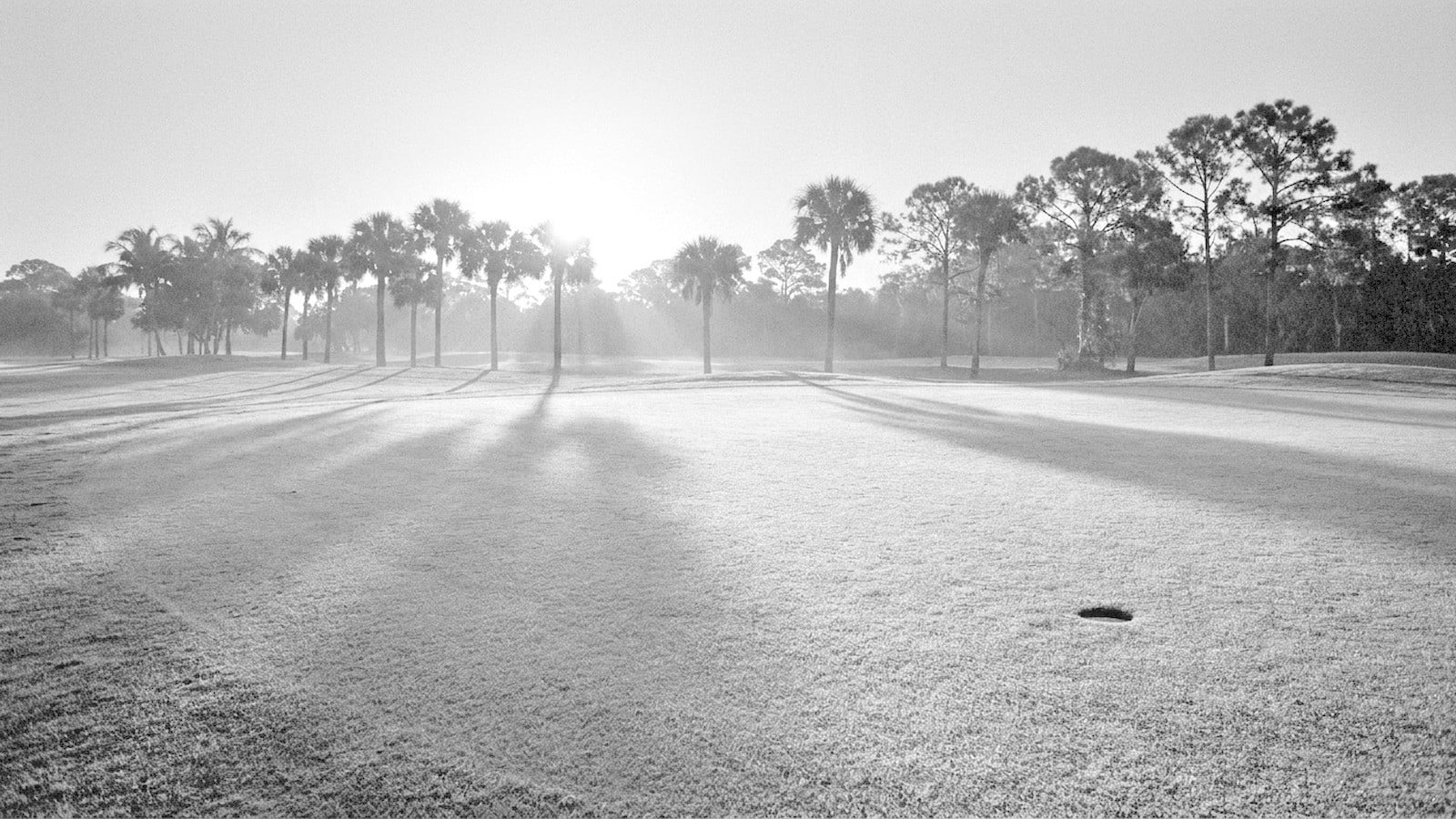
A walking round takes longer and demands more from the player. The pace is unhurried. You notice the course differently when you are on foot: the contouring, the pin positions, the way Nicklaus routed the holes through the natural landscape. The conditioning at Loxahatchee reflects the investment of a community where golf is the primary amenity, not one of several. Forbes recognized this with a Top 20 Platinum Club ranking for 2025-2026, an independent evaluation based on course quality, facilities, and member satisfaction.
The walking-only format also acts as a self-selecting filter. The members who choose Loxahatchee are golfers who play for the game itself, not for the convenience of a cart-based format. With one course serving 285 homes, peak-season weekend mornings still require planning ahead. This is a community of serious golfers and the popular tee times fill. But the overall pace of play and the weekday availability are meaningfully better than at larger communities. There, 600 to 900 memberships compete for the same morning window across two or three courses. The ratio of members to tee times is the advantage, and the walking format reinforces it by attracting a membership that values course conditions over convenience.
At a cart-based community, the course is one amenity among many. At Loxahatchee, the course is the organizing principle. The social connections, the daily rhythm, the sense of community that distinguishes this club from larger alternatives: most of it connects back to the walking experience. Some members stay through summer because of Florida residency or business reasons. But members who stay by choice report that the walking course is a meaningful draw. Buyers who prioritize golf over marina access, over multiple dining venues, over a packed events calendar, tend to find that Loxahatchee delivers more of what they actually use. The trade-off is that everything else is more modest in scale.
What 285 Homes Feels Like
The scale comparison is the fastest way to understand what Loxahatchee is and what it is not.
1.19-acre median lots on 488 acres. You may go days without encountering another member outside the clubhouse. The privacy is absolute. The social dynamic is occasional, not daily. Median home: $12.3M.
0.30-acre lots. Small enough that the dining room has regulars, not strangers. Large enough to sustain a Forbes Top 20 club program and a full social calendar. Median home: $2.17M all-time, ~$4.2M on recent sales.
Multiple sub-associations, marina, 45 holes of golf, extensive dining and fitness. The amenity breadth is unmatched. The trade-off is volume: larger membership, more competition for tee times and reservations. Median lot: 0.42 acres.
At 285 homes, Loxahatchee operates at the scale of a neighborhood, not a resort. You will see the same people at the practice green, in the fitness center, and at the bar after a round. Relationships develop because the community is small enough for repeated, unplanned contact. For couples, social life happens organically rather than through a curated events program. For seasonal residents, your return each fall is noticed. This is a community where the staff knows your name and your usual, and your neighbors notice when you are away.
The density is relevant here. At 0.30 acres per lot (roughly 13,000 square feet), the homes sit closer together than at Bears Club (1.19 acres) or Admirals Cove (0.42 acres). This is manageable estate living: a 4,800 SF home with pool, covered patio, and landscaping fits comfortably with standard setbacks. It is not the acreage to build guest houses or extensive outbuildings. Buyers who need that kind of land should look at Bears Club. Buyers who want a home that maintains itself without a full-time estate manager tend to find 0.30 acres perfectly functional.
Who Lives Here
Loxahatchee attracts a mix of full-time residents and seasonal members, with the balance tilting more toward full-time than many comparable Jupiter communities. The walking course is a factor: the most active members play frequently enough that seasonal visits feel insufficient, and the club culture rewards regular presence. The relationships that make the community feel like a neighborhood depend on people actually being there.
The age range skews toward established professionals and active retirees, typically 50s through 70s, though families with school-age children are present in smaller numbers. Loxahatchee is a golfer's community first. Admirals Cove, with its broader amenity base (marina, pools, tennis, children's programming), can attract a wider demographic range that includes young families. The families who are here chose it for the course and the culture, not for the kids' programs.
The price point plays a role in the composition. At a median of $2.17M all-time and roughly $4.2M on recent sales, the entry cost reaches a wider range of buyers. Bears Club runs a $12.3M median, and Lost Tree Village a $5.6M single-family median. This means the membership includes business owners, senior executives, and retired professionals alongside the ultra-high-net-worth profile that dominates higher-priced communities. The mix creates a club where the culture is informal by private club standards. Conversations lean toward the game and business rather than display, and the dress code signals comfort over performance.
A note on seasonal dynamics. Like most Jupiter corridor clubs, Loxahatchee's peak social season runs November through April. The club operates year-round, and the walking course is playable 12 months. But the dining room, the social calendar, and the competitive golf events concentrate in the winter months. Buyers planning to use Loxahatchee primarily October through May will find a full and active community. Full-time residents report that summer has its own rhythm: quieter, more relaxed, and the course is yours.
Amenities Beyond the Course
Loxahatchee's amenity program reflects its identity as a golf-first community. The clubhouse serves as the social center with dining, locker rooms, and a fitness facility. Practice facilities support the walking course. There is a pool. The scale is appropriate to 285 homes: the facilities are well-maintained and rarely feel crowded, which is a direct benefit of the community's size. Specific amenity details should be confirmed directly with the club: current dining formats, fitness equipment, court availability and practice facility scope all evolve. The most current picture comes from a visit or a conversation with membership, not a third-party summary.
What Loxahatchee does not have is what defines it as clearly as what it does. There is no marina (Admirals Cove). There is no 45-hole golf complex with multiple course designs (Admirals Cove, Mirasol). There is no resort-scale spa or children's activity center. The scope is deliberate. The membership dues support one course at an exceptional level rather than spreading investment across a portfolio of amenities that compete for the same budget.
For buyers who want their community to be the center of their social, fitness, and recreational life, Admirals Cove or Mirasol offer more breadth. For buyers who want a home base with a Forbes-ranked course, Loxahatchee's focused model works. Fitness, dining and social variety come from Jupiter's broader offerings, which are substantial.
The Housing Stock: Mostly Pre-2000, and That Shapes the Buying Decision
Of all transacted homes at Loxahatchee, 61% were built before 2000. Pre-1990 construction (33% of sales) carries a median of $502/SF. Homes from the 1990s (28%) carry $583/SF. Homes built after 2020 (6% of sales) trade at $1,034/SF, roughly double the per-foot cost of the older stock. The practical implication for most buyers is that the home you find will either need significant updating or command a premium for being already renovated.
This is not unusual for private Jupiter communities established in the 1980s. The original housing stock was built to the standards and tastes of that era. Kitchens, bathrooms, and outdoor living spaces in pre-2000 homes typically do not meet current buyer expectations. The renovation opportunity is real. A pre-1990 home acquired at $400 to $700/SF can be comprehensively updated and repositioned at $650 to $800/SF all-in, which remains well below the cost of newer or rebuilt inventory. But renovation inside the gates involves architectural review board approval, construction access regulations, and three to six months of design and permitting lead time before work begins. This is standard for private communities but adds timeline and coordination that should be factored into the purchase plan.
For buyers who want to walk in and start playing golf the next morning, the smaller inventory of 2000s and newer homes is the target. That stock is 19% of sales at $748 to $1,034/SF. For buyers willing to manage a renovation, the older stock offers a meaningfully lower entry point into the same community with the same club access. The choice between these two strategies is one of the first decisions to make, and it drives the search in different directions. An advisor who has guided renovations inside the community can help estimate the realistic timeline and scope before you commit.
Practical Logistics: Where You Are and What Is Nearby
Loxahatchee sits on the west side of Jupiter, along the Donald Ross Road corridor. This places it inland, away from the Intracoastal and ocean, but centrally positioned relative to Jupiter's commercial and recreational infrastructure.
Distances From Loxahatchee Club
The inland position is a trade-off worth naming. Loxahatchee does not have waterfront, ocean access, or Intracoastal views. Lost Tree Village, by contrast, combines private beach, Intracoastal frontage and golf within one gate. Admirals Cove has a 77-slip marina on the Intracoastal. If water access is a priority, Loxahatchee requires you to source it independently (Jupiter marinas, 15 minutes away). If water is secondary to golf, the inland position is a non-issue.
Bottom Line
Loxahatchee is the Jupiter corridor community that chooses depth over breadth. The walking course is the reason people come, and the 285-home scale is the reason they stay. The housing stock is older than most buyers expect, which creates both a renovation opportunity and a planning requirement. The amenity program is deliberately focused on golf, not diversified across a resort portfolio. And the inland position means water access is external. Loxahatchee answers a specific question for the buyer who has evaluated the alternatives. Bears Club is more exclusive, four times the price and a different product class. Admirals Cove holds more amenities and three times the inventory, and Lost Tree Village puts oceanfront, Intracoastal and golf in one gate. Where can you play a Forbes-ranked Nicklaus course every morning, know your neighbors and enter at a third to three-quarters of what the nearest alternatives cost? Whether that answer fits depends on what you prioritize. If you are weighing Loxahatchee against one or more of these communities, the most useful next step is a conversation with someone who has been inside all of them.
If golf is the priority and scale is secondary: Loxahatchee is the strongest value proposition in the Nicklaus corridor for the serious golfer. The walking format, the Forbes Top 20 course quality, and the 285-home intimacy create an experience that larger communities cannot replicate regardless of dues or initiation. The renovation calculus adds optionality: buy older at $400 to $700/SF, invest in updating, and end up in a home calibrated to your preferences rather than the prior owner's.
If amenity breadth or waterfront matters: Loxahatchee will feel like it is missing something. No marina, no beach club, no resort-scale programming. If your household includes non-golfers who want their own reasons to use the club, explore Admirals Cove or Lost Tree Village first. You can always come back to Loxahatchee if the golf draws you in, but you cannot add a marina or an ocean after the fact.
If you are visiting and want to experience the difference: Walk the course. Not on a screen, not from a listing photo. The distinction between a walking Nicklaus and a cart-based Nicklaus is something you feel in the pace, the conditioning, and the quiet. That walk will tell you whether this is your community more clearly than any data we can provide.
Transaction data (median prices / price per square foot / lot sizes / build eras / transaction counts) comes from 64 closed residential sales at The Loxahatchee Club in Jupiter. The window runs January 2020 through March 2026, via BeachesMLS/Spark API. Full data analysis, yearly trends and methodology disclosures are available in the companion PBL reports. They are "The Loxahatchee Club: What It Costs, How Membership Works, and What the Inventory Looks Like" and "Loxahatchee Club by the Numbers."
Observations about community culture, member demographics, seasonal dynamics and club amenities reflect practitioner experience advising buyers and sellers in the Jupiter corridor. So do the daily-life notes. These are directional characterizations based on repeated professional engagement with the community, not a formal survey of residents or club management. Prospective buyers should confirm current amenity offerings, club programming, and membership terms directly with The Loxahatchee Club.
Distance estimates are approximate driving times under normal traffic conditions and should be verified independently. School zone assignments are subject to change. Confirm current zoning with the School District of Palm Beach County.
Corridor comparisons (Bears Club, Admirals Cove, Lost Tree Village, Mirasol) reference data and practitioner knowledge from separate PBL analyses. Community sizes, amenity descriptions, and price positioning are cited for context only and are not drawn from a single standardized survey.
Transaction Data: BeachesMLS (Beaches Multiple Listing Service) via Spark API. Closed residential sales at The Loxahatchee Club, Jupiter, FL. January 2020 through March 2026. 64 transactions.
Club Recognition: Forbes / Platinum Clubs of the World, Top 20 ranking, 2025-2026 cycle.
Corridor Comparisons: PBL internal analysis of Bears Club estate sales, Lost Tree Village sales, and Admirals Cove sales from the same BeachesMLS/Spark API dataset.
Distance Estimates: Practitioner experience and standard mapping tools. Approximate driving times under normal conditions.